Sounding Rockets
Since 1994 DTM develops on behalf of ESA scientific experiments for sounding rockets that are launched from Swedish Space Corporation's launch facility Esrange in the north of Sweden
Source2 experiment
Prime Contractor SSC Swedish Space Corporation
On 13th of February 2012 the rocket MASER 12 has been launched from Esrange Space Center in Sweden. The experiments onboard had full success. DTM was responsible for the design (including structural and thermal analysis), manufacturing and test test of the mechanical and hydraulic systems of the Source2 experiment.
To allow to meet the scientific goals DTM designed the fluidic part as well as the heating and cooling system of the quartz cell which was the core part for the study of convection and boiling phenomena in microgravity condition (PI Prof. M.Dreyer ZARM Brema, Prof. C.Colin IMFT Tolouse, Dr. P.Behruzi Astrium Brema). The system was designed to withstand temperature upto 150°C in the hottest parts in order to guarantee a constant heat flow between top and bottom side of the quartz cell to study the Marangoni effect. The cell was specially designed in order to implement roughly 30 temperature sensors.
DTM has been also responsible for the design, manufacture and test of the composite carbon fibre outer structure of the Source2 module. This was the first CFRP experiment outer structure which ever flew on Maser missions
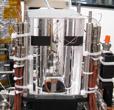 Source2 experiment core
during integration at DTM |
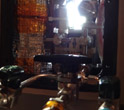 Source2 late access activities
at Esrange launch tower |
CDIC2 and Source experiments
Prime Contractor SSC Swedish Space Corporation
On 15th of May 2008 the rocket MASER 11 has been launched from Esrange. The experiments onboard had full success. DTM was responsible for the design (including structural and thermal analysis), manufacturing and test test of the mechanical and hydraulic systems of two experiments: CDIC2 and Source.
CDIC2 (PI Dr. K. Eckert TUD Dresden - Germania) had the aim to study chemically driven interfacial processes that are present in many industrial chemical processes. Source had the aim to study convection and boiling phenomena in microgravity condition. Among other goals this experiment will help understanding the behaviour of propellant in launcher tanks (PI Prof. M.Dreyer ZARM Brema, Prof. C.Colin IMFT Tolouse, Dr. P.Behruzi Astrium Brema).
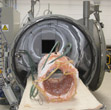 Source2 CFRP structure ready
for autoclave curing in DTM |
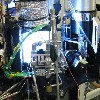 Source module during tests
at SSC Solna |
CDIC and TRUE2 experiments
Prime Contractor SSC Swedish Space Corporation
On 2nd of May 2005 the sounding rocket MASER 10 was launched from Esrange. MASER 10 reached an apogee of 252 km and a top speed of approx. 2 km/sec. The experiments onboard spent six minutes in microgravity and worked perfectly during the flight. DTM was involved in the design, development and testing of the mechanical system of two experiments on-board this MASER rocket: CDIC and True 2. CDIC (Principal Investigator Dr. K.Eckert of Technical Univerisity Dresden - Germany) had the aim to study chemically driven interfacial convection processes. TRUE had the aim to study thermal radiation forces in unsteady conditions (Principal Investigators Prof. F.S.Gaeta, Dr.C.Albenese, Dr.F.Peluso of MARS Centre Naples, Italy).
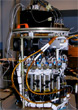 CDIC experiment during testing at
SSC Esrange laboratory |
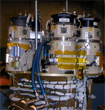 TRUE: Three of the six experiment cells mainly TRUE: Three of the six experiment cells mainly
made in polymeric material. |
Tem-Fer experiment
Prime Contractor Eads Space Transportation - Bremen
For the Prime Contractor EADS Space Transportation (former Daimler Benz Aerospace) an experiment was launched with full success in February 1998 and then in March 2003 (reflight). Professor Daniel Beysens of the CENG (Grenoble, France) is the Principal Investigator, that has specified the mechanical performance to be achieved by this module.
The two thermostats, whose temperature control has a maximum allowed variation of only 0.001 °C, are actuated by an acceleration system able to change both amplitude and frequency. The amplitude variation is achieved by a micrometric control of the crankshaft axial position, through a secondary motor and a special device. This three-dimensional shaft, grinded with a control accuracy in the order of the micron, couples - via connecting rods - the two slides supporting the thermostats.
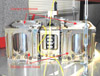 Beysens module during vibration test Beysens module during vibration test
at Università di Modena
Dylco experiment
Prima Contractor SSC Swedish Space Corporation
The picture on the left depicts the Maxus 2 rocket being launched from Esrange, on the right is shown the Dylco Experiment which was mechanically developed by DTM. The Prime contractor for this activity was Swedish Space Corporation while the Principal activity investigator was Professor Langbain of ZARM University of Bremen (Germany).
 Maxus 2 rocket launched from Maxus 2 rocket launched from
Esrange, Sweden |
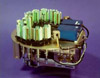 Dylco Experiment Dylco Experiment |
|







;)
;)
;)
;)
;)
;)
;)
;)
;)